RHCP vs LHCP: Which Circular Polarization Should You Use for FPV and Drones?

When you're picking a 5.8 GHz antenna for video, telemetry or control, you'll run into "RHCP" and "LHCP" almost immediately. Here's what the terms actually mean, why circular polarization matters for drones and FPV, and how to make sure your transmit and receive antennas actually agree with each other.

01 — Fundamentals

What Is Circular Polarization?

Polarization describes the orientation of a radio wave's electric field as it travels. With linear polarization, that field stays fixed along one axis — vertical, horizontal, or somewhere in between. With circular polarization (CP), the electric field instead rotates in a full circle once per RF cycle as the wave moves forward, tracing out a corkscrew shape through space.

There are two directions that rotation can go, and antennas are labeled accordingly:

  • RHCP — Right-Hand Circular Polarization
  • LHCP — Left-Hand Circular Polarization

"Right-hand" and "left-hand" describe the direction of rotation when you look along the direction the wave is travelling — the same convention antenna engineers use for satellite, radar and FPV links (note: optics and some other fields define handedness the opposite way, looking back toward the source, so double-check which convention a given datasheet uses if the two seem to disagree).

02 — How The Wave Rotates

RHCP vs LHCP Rotation

The diagram below shows both cases as the wave travels toward you. The only physical difference between RHCP and LHCP is this direction of rotation — the two perform identically in every other respect, including gain, bandwidth and radiation pattern, when built to the same design standard.
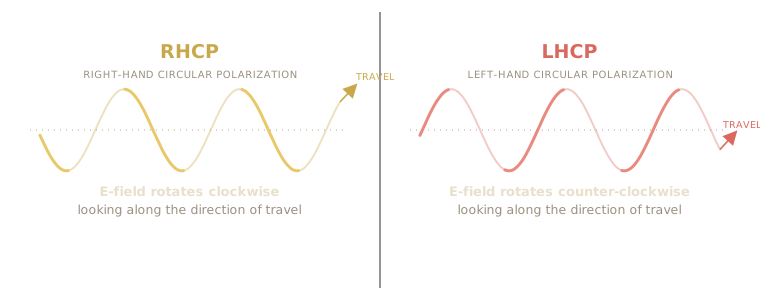
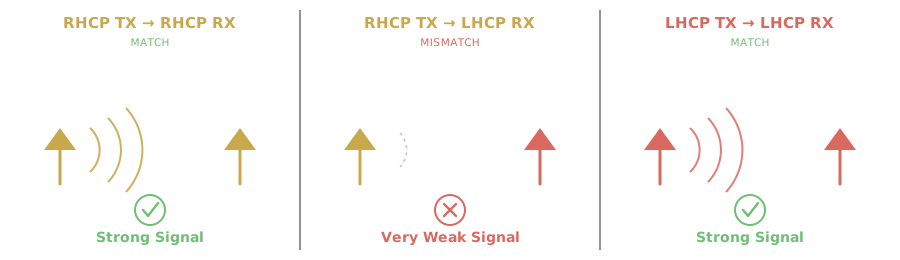
Diagram comparing RHCP and LHCP electric field rotation as the wave travels toward the viewer
Fig. 1 — Electric field rotation for RHCP (clockwise) and LHCP (counter-clockwise), viewed along the direction of propagation.
◆ Quick Field Test

Point your right hand's thumb in the direction the wave is travelling. If your fingers curl the same way the electric field rotates, it's RHCP; if they curl the opposite way, it's LHCP. This is simply the right-hand rule applied to the field's rotation.

03 — Why It Matters

Why FPV and Drone Links Use Circular Polarization

Most 5.8 GHz video, telemetry and control links use CP antennas rather than linear ones, for three practical reasons:

  • Better resistance to multipath. Signals reflecting off trees, buildings, water or the ground shift phase and can partially reverse a linear signal's polarization. A CP signal retains much more of its usable strength after a bounce.
  • No need for perfect alignment. A linearly polarized link loses signal fast as the transmit and receive antennas rotate out of alignment with each other — which happens constantly on a moving aircraft. A CP receive antenna stays matched to a CP transmit antenna regardless of roll, since the field is rotating symmetrically to begin with.
  • Fewer deep signal fades. The combination of the two effects above means CP links produce noticeably more stable video and control connections in real flying conditions than linear antennas of similar gain.
04 — Key Differences

RHCP vs LHCP: What Actually Differs

In ideal conditions, RHCP and LHCP antennas of the same design perform identically — same gain, same beamwidth, same efficiency. The only thing that differs is the direction of rotation, and that direction is not interchangeable:

RHCP and LHCP are not compatible with each other on the same link. The receive antenna must use the same hand as the transmit antenna.

If the transmitter is RHCP and the receiver is LHCP (or vice versa), the signal is heavily attenuated — often enough to break the link entirely at any meaningful range.

Typical cross-polarization isolation on a well-built CP antenna is in the 15–30 dB range, meaning a mismatched signal arrives roughly 30 to 1,000 times weaker than a matched one.

05 — Polarization Matching

What Happens When You Mismatch Polarization

Because RHCP and LHCP rotate in opposite directions, an antenna built for one essentially rejects the other. The comparison below shows the three possible pairings on a link:

Diagram showing strong signal for matched RHCP-RHCP and LHCP-LHCP pairs, and very weak signal for a mismatched RHCP-LHCP pair
Fig. 2 — Matched polarization (same hand on both ends) preserves signal strength; a mismatched pair loses most of the link.
⚠ Worked Example

With 20 dB of cross-polarization isolation, a mismatched receiver sees a signal 20 dB weaker than a matched one — that's 100 times less power arriving at the receiver. On most real links, that's enough to drop well below the noise floor.

This isolation effect isn't only a failure mode — it's also a deliberate design tool. Because a well-matched CP antenna rejects the opposite hand so strongly, engineers can run two independent links on the same frequency in the same location — one RHCP, one LHCP — with minimal interference between them. This is why some systems intentionally pair an RHCP video link with an LHCP control or telemetry link sharing the same band.

06 — Reference Data

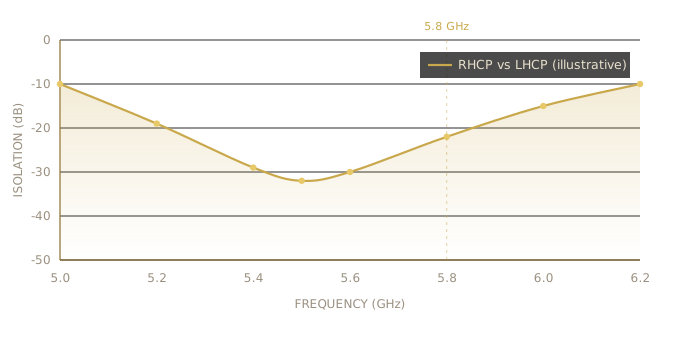
Typical Cross-Polarization Isolation

The chart below illustrates how cross-polarization isolation typically varies across a 5.8 GHz antenna's operating band — generally deepest near the antenna's design center frequency and shallower toward the band edges.

Chart showing typical cross-polarization isolation from 5.0 to 6.2 GHz, deepest near 5.5 GHz
Fig. 3 — Illustrative cross-polarization isolation curve for a well-optimized 5.8 GHz CP antenna. Actual figures vary by design — check the antenna's datasheet for measured values.
◆ On Linear Antennas, For Comparison

Pairing a linear antenna with a circular one costs about half the available power (~3 dB) regardless of orientation, since only one component of the rotating field is picked up. Two linear antennas avoid that loss only if their orientations happen to match — which is exactly the alignment problem circular polarization was adopted to solve.

07 — Making The Choice

Which One Should You Use?

There is no universal rule — RHCP and LHCP are equally valid engineering choices. What actually matters is that every antenna on a given link uses the same hand.

Choose RHCP if…

You're matching an existing FPV ecosystem — most commercial 5.8 GHz video transmitters, receivers, goggles and off-the-shelf antennas (including Kreita's EGLE series) default to RHCP, so it's the path of least resistance for plug-and-play compatibility.

Choose LHCP if…

Your equipment specifies it, or you're deliberately isolating a second link (e.g. control or telemetry) from an existing RHCP video link sharing the same band. Some regions and specific systems also standardize on LHCP.

Always check what your VTX, receiver and goggles actually support before buying antennas, and match every antenna on the link to it. Mixing hands anywhere in the chain is one of the most common — and most avoidable — causes of a "dead" link that otherwise looks correctly built.

Summary
  • RHCP and LHCP are two forms of circular polarization that rotate in opposite directions — otherwise, they perform identically.
  • For best performance, use the same polarization hand on both ends of the link.
  • Mismatched CP antennas lose 15–30 dB or more, often enough to break the link entirely.
  • CP antennas give more reliable links than linear ones, especially for drones and FPV where orientation is constantly changing.
Related Antennas

↗ Model your link's range with the Link Budget Calculator

Frequently Asked Questions

Polarization FAQ

What is circular polarization in an antenna?
Circular polarization is a wave state where the electric field rotates in a circle as the wave travels, rather than staying fixed along one axis as it does with linear polarization. It's described as right-hand (RHCP) or left-hand (LHCP) depending on which way that rotation goes when viewed looking along the direction of travel.
Can I mix RHCP and LHCP antennas on the same link?
Not for the same link. RHCP and LHCP are opposite-handed, so pairing them on one transmitter-receiver link causes heavy cross-polarization loss — typically 15 to 30 dB or more — and will usually break the connection. The transmit and receive antenna must use the same sense of circular polarization.
Why do most FPV video systems use RHCP?
RHCP became the de facto default for 5.8 GHz analog and digital FPV video gear early on, and most goggles, receivers, VTX modules and off-the-shelf antennas in that ecosystem still ship as RHCP, so pilots default to it for plug-and-play compatibility. LHCP isn't inferior — it's used deliberately in some systems to isolate a second link sharing the same band.
What is cross-polarization isolation and why does it matter?
Cross-polarization isolation is how many dB weaker a signal appears when received on the opposite sense of circular polarization compared to the matched sense. High isolation — typically 20 dB or more on a well-designed antenna — is what lets engineers run two independent RHCP and LHCP links on the same frequency at the same location with minimal interference between them.
Does polarization matching matter for linear antennas too?
Yes. Linear antennas lose signal from misalignment — a vertical antenna paired with a horizontal one loses most of the link — and a linear antenna paired with a circular one always loses about half the power, roughly 3 dB, regardless of orientation. Circular polarization avoids the alignment problem but still requires matching hand between transmitter and receiver.
Order & Contact
Building an RHCP Link?

Every EGLE antenna is RHCP, designed and measured in Lithuania for 5.0–6.2 GHz FPV, UAV and point-to-point use. Tell us your setup and we'll help you match gain and polarization correctly the first time.